

An air conditioner plays an essential role in maintaining a comfortable indoor environment, especially during hot and humid weather. Whether you rely on your AC to keep your home cool during the day or to help you sleep comfortably at night, a properly functioning system makes a significant difference in your daily life.
However, like any mechanical system, an air conditioner can develop problems over time. Some issues begin with subtle changes in cooling performance, while others appear suddenly and require immediate attention. Recognizing these warning signs early can help you avoid more extensive repairs, reduce unnecessary energy consumption, and extend the life of your equipment.
If your air conditioner is no longer performing as expected, understanding when to call for ASAP heating and cooling help is critical. In this guide, we'll explore 10 common signs your AC needs professional repair, explain what may be causing each problem, and discuss when to seek expert assistance.
1. Your Air Conditioner Is Blowing Warm or Hot Air
One of the clearest signs of an AC problem is air that feels warm when the system is supposed to be cooling your home.
When your air conditioner runs but fails to produce sufficiently cool air, several underlying issues could be responsible.
Possible causes include:
• Low refrigerant levels caused by a leak.
• A malfunctioning compressor.
• Dirty condenser coils that interfere with heat transfer.
• Problems with the thermostat or its settings.
• Electrical or control-system faults.
• Restricted airflow caused by a clogged air filter.
Start by checking that your thermostat is set to cooling mode and that the temperature setting is appropriate. You can also inspect the air filter and replace it if it is dirty, following the manufacturer's instructions.
If the system continues blowing warm air after these basic checks, professional diagnosis is recommended. Refrigerant leaks, compressor faults, and electrical problems require appropriate tools and technical expertise.
An experienced technician can identify the underlying cause instead of simply treating the symptom.
When to call for repair : Contact an AC professional if your system consistently produces warm air, struggles to reach the set temperature, or stops cooling altogether.
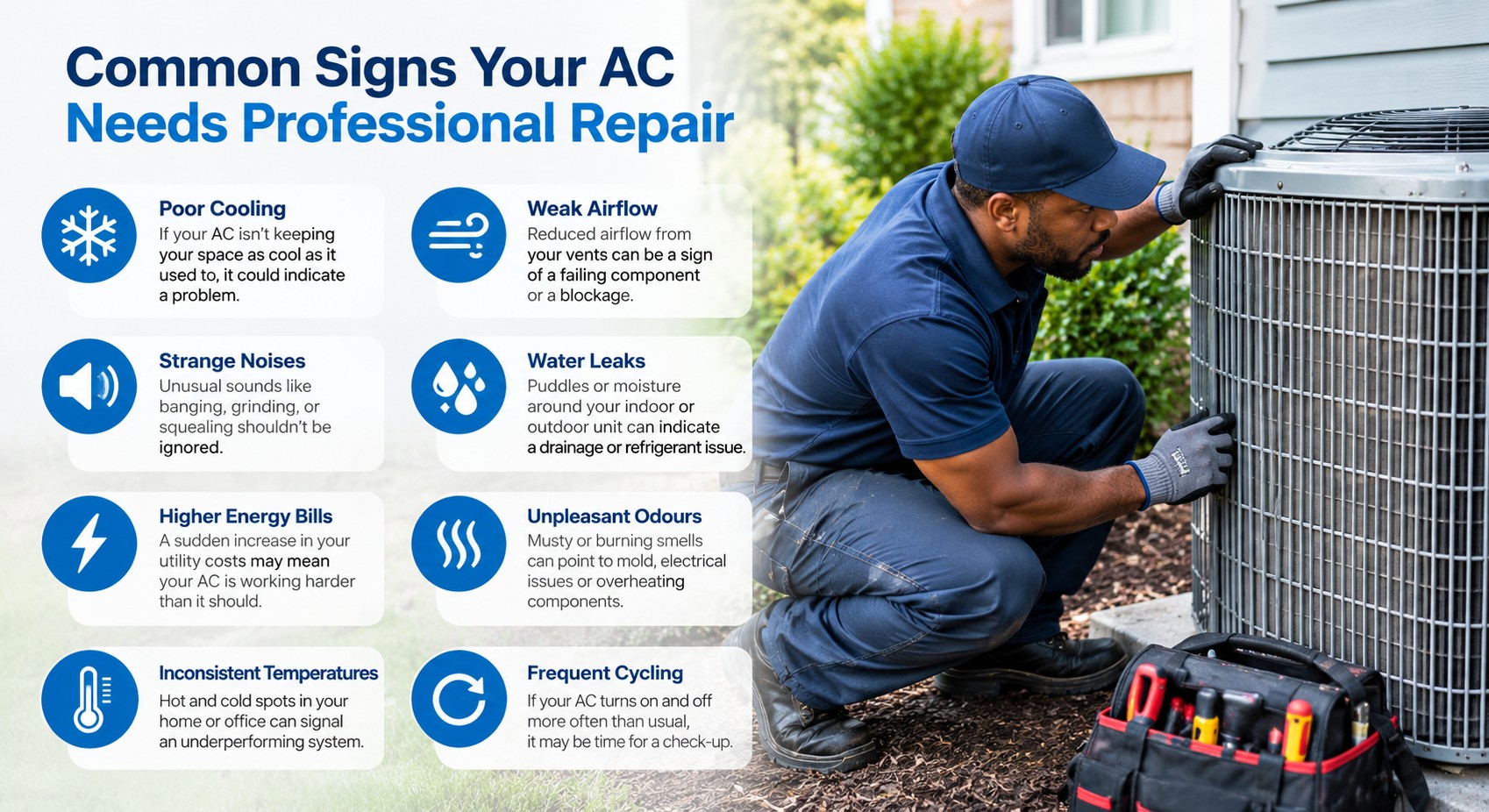
2. Your AC Is Making Unusual Noises
Air conditioners normally produce some sound during operation. You may hear the gentle hum of the indoor fan, the sound of air moving through vents, or the outdoor unit starting and stopping.
However, sudden, unusually loud, or persistent noises may indicate a mechanical problem.
Pay attention to the following sounds:
• Banging or clanking: Loose or damaged internal components may be moving around.
• Grinding: A motor or bearing may be worn or damaged.
• Squealing or screeching: A motor, bearing, or other moving component may need attention.
• Buzzing: Possible causes include electrical faults, loose components, or a struggling motor.
• Repeated clicking: A faulty control, relay, or electrical component may be involved.
• Hissing: This can indicate an air leak, pressure-related issue, or refrigerant leak, depending on where the sound originates.
The type and location of the noise can help a technician narrow down the possible cause.
Do not ignore unusual sounds simply because the AC is still cooling. A relatively minor mechanical issue can become more serious if the system continues operating with damaged components.
If you hear loud grinding, repeated hard impacts, or signs of an electrical fault, switch the system off if it is safe to do so and arrange professional inspection. If you notice smoke or a burning smell, stop using the equipment and seek appropriate assistance.
When to call for repair: Have your system inspected whenever a new, persistent, or unusually loud noise develops.
3. Your Energy Bills Have Increased Unexpectedly
An unexplained increase in your electricity bill can be another sign that your air conditioner needs attention.
Air conditioning systems consume more energy when they must work harder to maintain the desired indoor temperature. When a component is malfunctioning, the system may run longer than usual or operate less efficiently.
Common reasons for increased AC energy consumption include:
• Dirty air filters restricting airflow.
• Dirty evaporator or condenser coils.
• Refrigerant problems.
• A failing fan motor or compressor.
• Thermostat malfunctions.
• Leaky or poorly insulated ductwork.
• Incorrect system sizing or persistent cooling demands.
Before assuming your AC is faulty, consider other factors that influence electricity consumption. Hotter weather, changes in occupancy, longer operating hours, and changes in electricity rates can also affect your bill.
If your energy costs rise while your cooling performance declines, however, it is worth investigating the system.
A professional AC inspection can reveal whether a maintenance issue, damaged component, or another problem is causing the system to consume more energy than necessary.
When to call for repair: Seek professional assistance if your electricity bills rise unexpectedly alongside longer cooling cycles, weak airflow, or reduced comfort.
4. Weak Airflow Is Coming From Your Vents
If your air conditioner is running but very little air comes out of the vents, the system may have an airflow problem.
Weak airflow can make rooms uncomfortable and force your AC to operate for longer periods without delivering the expected results.
Several issues can cause this problem:
A dirty air filter: Dust and debris can accumulate in the filter, restricting the amount of air that passes through the system.
Blocked vents: Furniture, curtains, or other objects may obstruct supply or return vents.
Blower motor problems: A damaged or failing blower motor may prevent the system from moving enough air.
Frozen evaporator coils: Ice buildup can obstruct airflow through the indoor unit.
Ductwork problems: Leaks, crushed ducts, disconnected sections, or obstructions can reduce the amount of conditioned air reaching your rooms.
Begin with simple checks, such as replacing a dirty filter and making sure the vents are open and unobstructed.
If airflow remains weak, a technician can inspect the blower, evaporator coil, ductwork, and other components to identify the cause.
Avoid repeatedly running an AC system with suspected frozen coils. Continued operation can worsen the problem or contribute to equipment damage.
When to call for repair: Arrange professional service if airflow remains weak after basic checks or if you notice ice on the equipment.
5. Your AC Frequently Turns On and Off
An air conditioner normally cycles on and off as it works to maintain the temperature selected on the thermostat. However, if the system starts and stops much more frequently than usual, it may be experiencing a problem known as short cycling.
Short cycling can prevent your home from reaching a comfortable temperature and may increase wear on components that start repeatedly.
Potential causes include:
• A malfunctioning thermostat.
• A dirty air filter or restricted airflow.
• Refrigerant-related problems.
• An overheating compressor.
• Electrical or control-system faults.
• An AC unit that is oversized for the space it serves.
Short cycling should not be dismissed as a minor inconvenience. Frequent starts can place additional stress on the compressor and other components.
Check that the thermostat is not positioned near a heat source, direct sunlight, or another location that could cause inaccurate readings. Also, inspect the air filter.
If the system continues cycling frequently, a technician should determine why.
The solution depends on the underlying cause. A thermostat adjustment may resolve one situation, while another may require electrical repairs, airflow corrections, or a more detailed system assessment.
When to call for repair: Contact an AC professional if your system repeatedly starts and stops without completing normal cooling cycles.
6. You Notice Water Leaks or Excessive Moisture Around the Unit
Air conditioners naturally produce condensation as they remove moisture from indoor air. Under normal conditions, that moisture drains away through a designated drainage system.
Water pooling around the indoor unit, dripping from an unusual location, or leaking into nearby walls or ceilings may indicate a problem.
Common causes include:
• A clogged condensate drain line.
• A damaged or improperly positioned drain pan.
• A disconnected drain pipe.
• A frozen evaporator coil that releases excess water when it thaws.
• Improper installation or drainage.
Water leaks deserve prompt attention because they can damage flooring, ceilings, walls, and nearby belongings. Persistent moisture can also encourage mold growth.
If you notice water around the equipment, switch the AC off if it is safe to do so, especially if water is near electrical components. Avoid opening electrical compartments or attempting repairs yourself. A qualified technician can inspect the condensate drainage system, check for ice buildup, and identify any damaged components.
If water is leaking through a ceiling, protect the affected area if possible without approaching electrical hazards, and arrange prompt assistance.
When to call for repair: Seek professional service if water continues to collect around the unit, drainage appears blocked, or moisture is damaging nearby surfaces.
7. There Is Ice on the Evaporator Coil or Refrigerant Lines
Ice on an air conditioner may seem surprising, particularly when the system is being used during hot weather. Nevertheless, frozen components are a recognized warning sign that the equipment may not be operating correctly.
An air conditioner can freeze up for several reasons, including:
• Restricted airflow from a dirty filter.
• A malfunctioning blower fan.
• Dirty evaporator coils.
• Low refrigerant caused by a leak.
• Other problems affecting the system's operating conditions.
When airflow or refrigerant conditions are abnormal, the evaporator coil may become cold enough for moisture to freeze on its surface. The ice can then restrict airflow further, reducing cooling performance and potentially causing additional problems.
If you see ice on the indoor unit or refrigerant lines, switch the system off and arrange professional inspection. Follow the manufacturer's guidance for safe shutdown and thawing. Do not chip away the ice or use sharp tools to remove it.
Also, do not assume that adding refrigerant is the solution. If refrigerant is low, a leak or another underlying problem may need to be identified and addressed.
A technician can inspect the airflow, coil condition, refrigerant system, and related components to determine the cause.
When to call for repair: Contact a professional as soon as you notice ice on your AC equipment, particularly if cooling performance has deteriorated.
8. Your AC Produces Unpleasant or Burning Smells
An unusual odor coming from your air conditioner can provide important clues about the system's condition. Different smells may point to different problems, although odor alone is not enough to establish a definite diagnosis.
Musty or damp smells
A musty odor may indicate moisture accumulation, a dirty filter, a contaminated drain pan, or microbial growth on damp surfaces.
Burning or electrical smells
A burning-plastic or electrical odor may indicate an overheating motor, damaged wiring, or another electrical fault.
Turn off the system if it is safe to do so. Do not continue operating the AC to see whether the smell disappears. If you notice smoke or an active fire hazard, move away and contact emergency services as appropriate.
Persistent chemical or unusual odors
A chemical-like smell can have several causes, including nearby household products, building materials, or a problem involving the equipment. The odor itself does not prove that refrigerant is leaking, since refrigerants are not always readily detectable by smell.
If you suspect a refrigerant leak, avoid handling the refrigerant circuit and arrange professional assessment.
When to call for repair: Arrange an inspection for persistent unexplained odors. Treat burning smells, smoke, or other signs of an electrical hazard as urgent.
9. Your Home Feels Humid Even When the AC Is Running
Air conditioners do more than cool indoor air. They also remove some of the moisture from the air as part of the cooling process.
If your home feels unusually sticky, damp, or humid even when the AC is running, the system may not be removing moisture effectively.
Potential causes include:
• An air conditioner that is oversized for the space.
• Short cycling that prevents sufficient moisture removal.
• Restricted airflow or dirty coils.
• Refrigerant-related problems.
• Poor drainage.
• High outdoor humidity combined with air leaks or other building issues.
An oversized system can cool a room quickly without running long enough to remove as much moisture as needed. In other cases, the issue may involve a malfunctioning component or conditions outside the AC itself.
Excess humidity can make indoor spaces feel less comfortable. Persistent moisture may also contribute to condensation, damp surfaces, and mold growth.
If possible, use a suitable hygrometer to measure indoor relative humidity rather than relying exclusively on how the air feels. Indoor humidity varies with the climate, building conditions, and ventilation.
A technician can assess the system's performance and determine whether a repair, maintenance service, airflow adjustment, or broader evaluation is appropriate.
When to call for repair: Seek professional advice if your home remains uncomfortably humid despite normal AC operation, especially when the problem occurs alongside weak cooling or short cycling.
10. Your Air Conditioner Struggles to Keep Up With the Thermostat Setting
Another sign that your AC may need professional repair is the inability to maintain the temperature you select.
For example, you might set the thermostat to a comfortable temperature, but the room remains warm for hours. The system may run almost continuously without bringing the indoor temperature down as expected.
This can happen for several reasons:
• Dirty filters or coils.
• Refrigerant problems.
• A malfunctioning compressor.
• A failing fan motor.
• Thermostat calibration or placement issues.
• Leaky ductwork.
• Poor insulation or significant heat entering the building.
• An AC system that is incorrectly sized for the space.
First, confirm that the thermostat is set to the correct mode and that the desired temperature is reasonable for the conditions. Make sure windows and doors are closed where appropriate, and check for obvious obstructions around vents.
If the AC still cannot maintain a comfortable temperature, a professional inspection can help distinguish an equipment fault from a problem involving the building or system design.
Identifying the actual cause is important because replacing a component will not solve a problem caused by duct leakage, excessive heat gain, or incorrect equipment sizing.
When to call for repair: Contact an HVAC professional if the AC consistently fails to reach the thermostat setting, runs for unusually long periods, or delivers progressively weaker cooling.
How ASAP Heating and Cooling Help Can be Invaluable
When your air conditioner begins showing warning signs, identifying the underlying problem is the first step toward restoring comfortable indoor conditions.
ASAP heating and cooling repairs offer several potential benefits:
1. They may prevent further equipment damage. A developing fault can place additional stress on other components. Addressing the problem early may reduce the likelihood of secondary damage.
2. They can help restore cooling performance. Identifying the underlying fault allows the technician to recommend an appropriate repair instead of relying on repeated temporary fixes.
3. They may reduce unnecessary energy consumption. Correcting airflow restrictions, faulty controls, or other performance problems can help the system operate more efficiently.
4. They can protect your home from water damage. Prompt attention to drainage problems may prevent moisture from spreading to ceilings, walls, flooring, and nearby belongings.
5. They help you make informed repair-or-replacement decisions. A professional assessment can clarify the condition of the system, the likely cost of repair, and whether replacement deserves consideration.
ASAP Cooling and Heating is a relevant service contact to consider when you urgently need assistance evaluating AC performance, diagnosing a suspected fault, or determining the next steps for repair.
Depending on the services available in your area, professional AC service may include:
• Inspecting cooling performance and airflow.
• Checking thermostat operation and system controls.
• Evaluating accessible filters, coils, and drainage components.
• Investigating unusual noises and operating patterns.
• Diagnosing refrigerant-related issues using appropriate procedures.
• Assessing electrical and mechanical faults.
• Recommending repairs or explaining when replacement may be more practical.
Before scheduling service, describe the symptoms you have noticed, when they began, and whether the problem is constant or intermittent. Mention any unusual noises, smells, leaks, or changes in your electricity consumption.
This information can help the service provider understand the problem and determine what should be checked.
For homeowners searching online for asap heating and cooling, the priority should be finding a qualified HVAC professional who can evaluate the specific problem, explain the recommended solution, and provide clear information about costs before proceeding.
ASAP Cooling and Heating can be a starting point for homeowners looking into AC service and repair. Contact the provider to confirm its service area, availability, and repair options.
A timely diagnosis, appropriate repairs, and consistent maintenance can help keep your air conditioner operating as reliably and efficiently as possible when you need it most.