

When your air conditioner starts malfunctioning, one of the biggest decisions you may face is whether to repair the existing system or invest in a replacement. While a simple repair might seem like the most affordable option, repeatedly fixing an aging or inefficient air conditioner can become expensive over time. On the other hand, replacing a system that only needs a minor repair could mean spending thousands of dollars unnecessarily.
So, how do you determine whether AC repair or replacement is the better choice? The answer depends on several factors, including your air conditioner's age, the nature and cost of the problem, its energy efficiency, how frequently it breaks down, and your long-term comfort needs.
In this guide, we'll explore the key differences between repairing and replacing an air conditioner, the warning signs to look out for, and how to decide which option makes the most financial and practical sense.
7 Factors to Consider When Deciding Between AC Repair and Replacement
There is no universal answer to the AC repair vs. replacement question. However, the following factors can help you evaluate your situation.
1. Consider the Age of Your Air Conditioner
The age of your air conditioning system is one of the most important factors to consider.
Most central air conditioning systems have an average lifespan of approximately 12 to 17 years, although actual service life varies depending on usage, installation quality, climate, and maintenance history.
If your system is relatively new, repairing it will often make more financial sense, provided the problem is not unusually expensive or extensive.
However, when an air conditioner approaches or exceeds its expected lifespan, replacement becomes increasingly worth considering.
Older systems are more likely to experience component failures, reduced cooling performance, and declining efficiency. Even when an older unit can still be repaired, another problem may develop shortly afterward.
Consider these general guidelines:
• Under 5 years: Repair is usually the preferred option, particularly if the system has been properly maintained.
• 5–10 years: Repair will often make sense, although the severity and cost of the problem should be considered.
• 10–15 years: Compare the repair cost with the potential benefits of installing a newer system.
• Over 15 years: Replacement may offer better long-term value, especially if the system requires expensive or repeated repairs.
These are guidelines rather than strict rules. A well-maintained older system may continue operating reliably, while a poorly installed or neglected younger unit may require replacement sooner.
2. Compare the Cost of Repairs With Replacement Costs
Another important consideration is how much the repair will cost compared with purchasing and installing a new air conditioner.
A relatively inexpensive repair may be worthwhile, even if your system is several years old. However, spending a significant amount on an aging unit can be difficult to justify.
For example, consider two situations:
Situation A:
Your air conditioner is seven years old and needs a relatively inexpensive capacitor replacement. The repair is straightforward, and the rest of the system is operating properly.
In this situation, repairing the unit is likely the more sensible financial decision.
Situation B:
Your 16-year-old air conditioner has a failing compressor, and the repair estimate represents a substantial percentage of the cost of a new system.
In this case, replacement may be a better investment, particularly if the unit has a history of breakdowns.
A useful guideline is the 50% rule: If the estimated repair cost approaches or exceeds 50% of the cost of a comparable new system, replacement deserves serious consideration. However, this is not a universal industry standard. The decision should also account for the unit's age, efficiency, warranty coverage, and expected remaining lifespan.
Always request a detailed repair estimate and a separate replacement quote before making your decision.
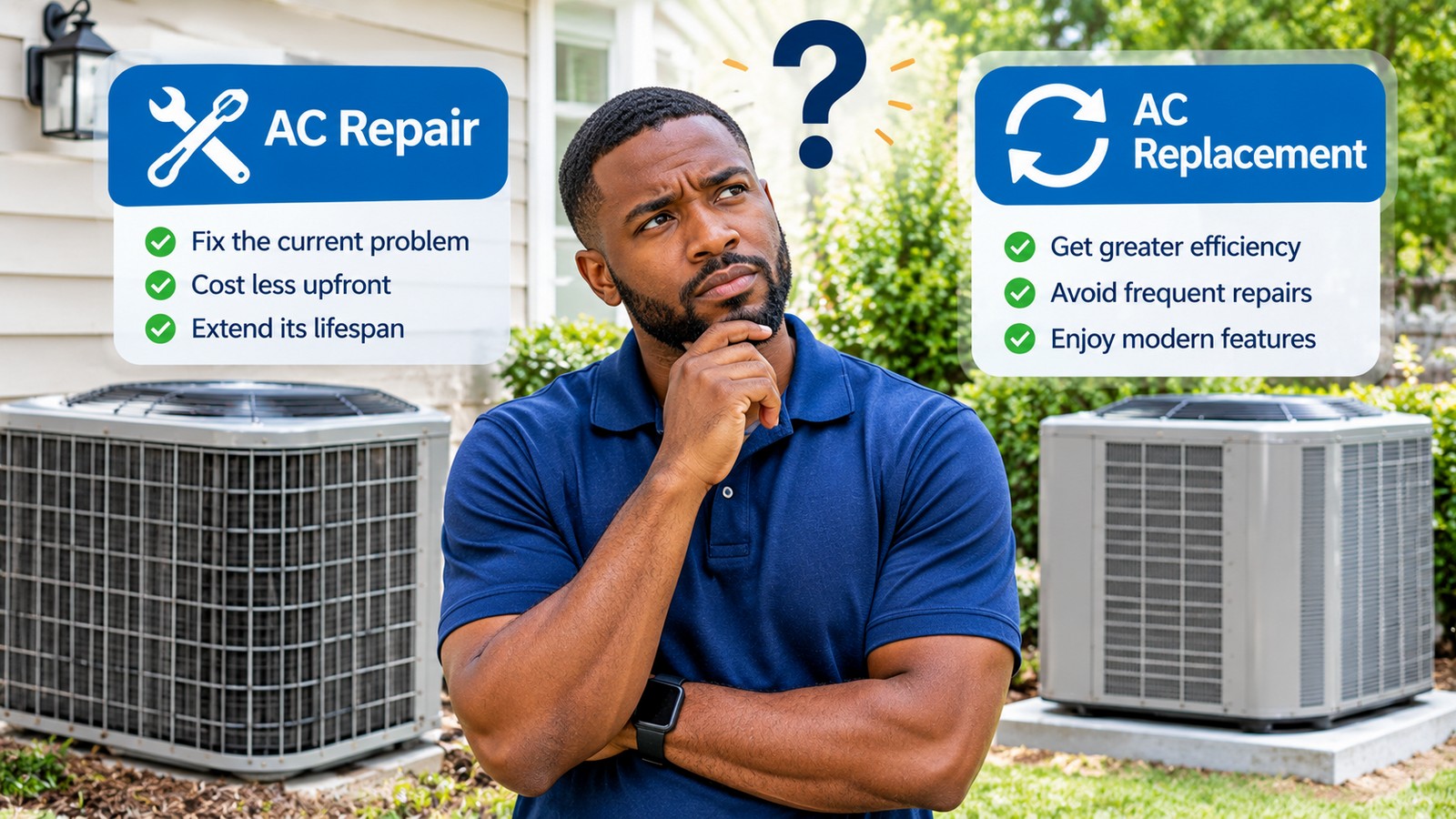
3. Evaluate How Frequently Your AC Breaks Down
An air conditioner that requires occasional repairs is not necessarily a candidate for replacement.
However, if you find yourself repeatedly calling technicians to fix different problems, it may indicate that the system is approaching the end of its useful life.
Frequent breakdowns create several problems:
• Repair expenses accumulate over time.
• Unexpected failures can disrupt your comfort.
• Older components may continue deteriorating.
• You may experience inconsistent cooling.
• The overall cost of maintaining the system may become difficult to justify.
For example, spending a small amount on an isolated repair may be reasonable. But if you have already paid for several repairs within the past year and another major component fails, continuing to repair the system may no longer be economical.
Keep records of previous repairs, including their costs and the components involved. This information can help an HVAC professional determine whether your system is experiencing isolated problems or widespread deterioration.
4. Check Your Air Conditioner's Energy Efficiency
Energy efficiency is another important factor when comparing AC repair and replacement. Older air conditioners may consume significantly more electricity than newer, properly sized, high-efficiency models.
An air conditioner may also lose efficiency as components wear out. Problems such as dirty coils, refrigerant issues, restricted airflow, and failing motors can force the system to work harder than necessary.
If your electricity bills have increased despite relatively consistent usage, your air conditioner may be contributing to the problem.
Have a technician inspect it, however, before deciding to replace the system. Some efficiency problems can be corrected through relatively inexpensive repairs or maintenance. If the system is old and consistently inefficient, upgrading to a newer model may reduce energy consumption over time.
When evaluating replacement options, compare their SEER2 ratings. SEER2 measures the seasonal cooling efficiency of air conditioners, with higher ratings generally indicating greater efficiency.
Remember that the actual savings will depend on your local climate, electricity rates, system sizing, installation quality, and cooling habits.
5. Pay Attention to Your AC's Cooling Performance
Your air conditioner should provide reasonably consistent cooling throughout the areas it serves. If certain rooms remain uncomfortable while others become excessively cold, something may be wrong with the system.
Common cooling performance problems include:
• Weak airflow from supply vents.
• Warm air coming from the air conditioner.
• Uneven temperatures between rooms.
• Difficulty reaching the thermostat's temperature setting.
• An air conditioner that runs continuously without adequately cooling the space.
These symptoms do not automatically mean you need a replacement.
Issues such as dirty air filters, blocked vents, thermostat problems, refrigerant leaks, and ductwork restrictions can often be corrected through repairs.
However, if your system continues struggling to cool your home despite professional servicing, replacement may be worth considering.
A technician should also evaluate whether the existing system is correctly sized for your property. An undersized or oversized air conditioner may experience performance problems even when its components are functioning properly.
6. Consider the Availability of Replacement Parts
As air conditioning systems get older, finding suitable replacement parts can become increasingly difficult.
Some manufacturers discontinue older models, making certain components harder to obtain. In other cases, replacement parts may still be available but considerably more expensive than those used in newer systems.
This can increase repair costs and extend the time required to restore your air conditioner.
If your system requires specialized components that are difficult to source, replacement may be a more practical long-term solution.
You may ask your HVAC technician whether the required parts are readily available and whether additional repairs are likely to become difficult or expensive.
7. Check Whether Your AC Is Still Under Warranty
Check your air conditioner's warranty coverage before agreeing to an expensive repair or deciding to replace it. Many manufacturers offer limited warranties on major components, although coverage periods and conditions vary by manufacturer and model.
If your compressor, condenser coil, or another major component is still covered, you may be able to reduce your repair expenses considerably.
Remember that warranties may cover parts without covering labor, refrigerant, transportation, or other associated costs, however.
If your system is relatively new and has a valid warranty, repairing it may be the more economical option.
Always verify the warranty terms and confirm whether the original installation and required maintenance conditions have been satisfied.
When Should You Replace Your Air Conditioner?
Replacement becomes more attractive when the existing system is no longer economical or reliable to maintain.
Consider installing a new air conditioner when:
• Your current system is significantly older than its expected lifespan.
• A major component has failed and replacement is expensive.
• You have experienced multiple breakdowns within a relatively short period.
• Your system has consistently poor energy efficiency.
• Cooling performance remains inadequate despite professional repairs.
• Replacement parts are becoming increasingly difficult to obtain.
• The estimated long-term repair expenses outweigh the benefits of keeping the existing unit.
A new air conditioner can provide several advantages, including improved energy efficiency, more consistent cooling, quieter operation, and modern temperature-control features.
However, replacement should involve more than simply selecting a newer version of your existing unit.
An HVAC professional should assess your property's cooling requirements, insulation, ductwork, and other relevant factors to recommend an appropriately sized system.
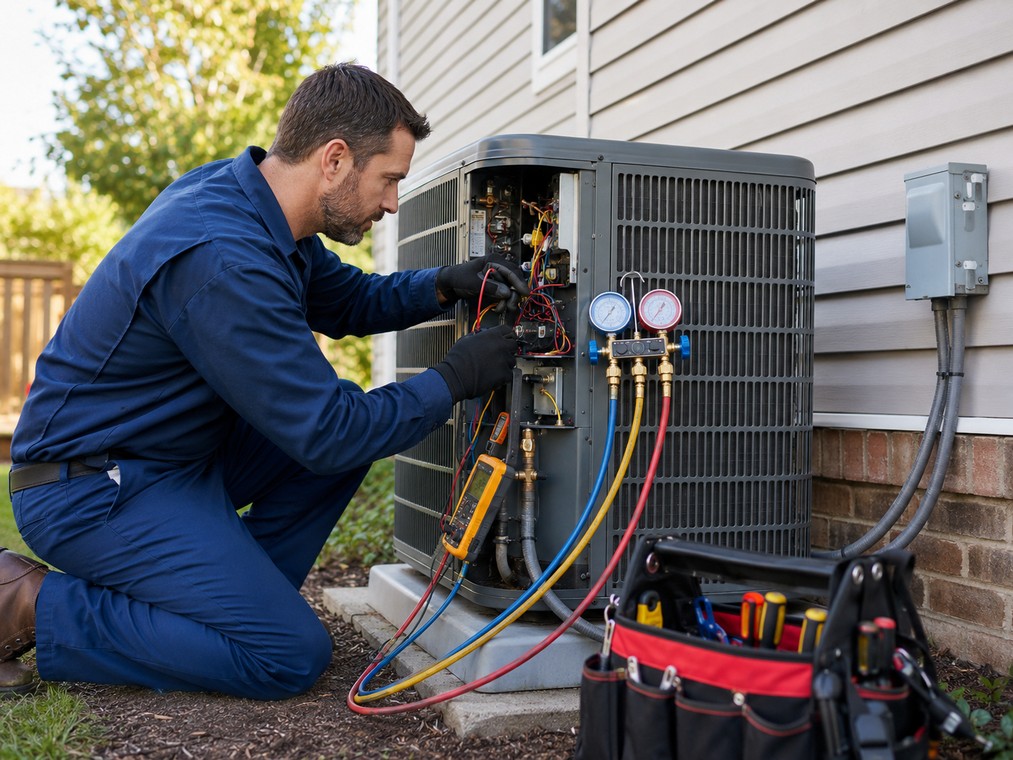
How Regular Maintenance Can Help You Avoid Premature AC Replacement
Whether you decide to repair your existing air conditioner or install a new one, regular maintenance is essential.
Proper maintenance helps identify developing problems before they become expensive failures. It can also improve energy efficiency, support consistent cooling, and extend the useful life of your equipment.
Here are some important maintenance practices:
Replace or clean air filters regularly: Dirty filters restrict airflow and make your air conditioner work harder. Follow the manufacturer's recommendations for cleaning or replacement.
Keep outdoor condenser units clear: Remove leaves, grass, dirt, and other obstructions that could restrict airflow around the outdoor unit.
Schedule professional inspections: Have a qualified HVAC technician inspect electrical connections, refrigerant levels, coils, motors, and other important components.
Keep vents unobstructed: Furniture, curtains, and other objects should not block supply or return air vents.
Pay attention to unusual changes: Strange noises, unusual odors, water leaks, and declining cooling performance should be investigated promptly.
If you invest in a new air conditioner, following its maintenance schedule can help protect that investment and reduce the likelihood of premature failure.
Why a Professional HVAC Assessment Matters
While the factors discussed in this guide can help you evaluate your options, deciding between AC repair and replacement ultimately requires an accurate diagnosis.
An experienced HVAC technician can inspect your existing system, identify the underlying problem, estimate repair costs, and evaluate its overall condition.
A professional assessment should ideally include:
• A complete inspection of the air conditioning system.
• Identification of faulty or deteriorating components.
• An estimate of the required repairs.
• An evaluation of the system's energy efficiency.
• An assessment of its remaining useful life.
• A comparison of repair costs against replacement options.
You should also request clear explanations of the available options rather than automatically accepting a recommendation to replace your system.
A trustworthy HVAC professional should help you understand the advantages and disadvantages of each option so you can make a decision that suits your budget and comfort requirements.
Conclusion: Should You Repair or Replace Your AC?
Choosing between AC repair and replacement requires balancing immediate expenses against long-term value.
If your air conditioner is relatively new, has a minor problem, and continues to provide reliable cooling, repairing it is usually the more economical option.
However, if your system is approaching the end of its expected lifespan, experiences frequent breakdowns, consumes excessive energy, or requires expensive repairs, replacement may be a smarter investment.
Ultimately, the best decision depends on the state of your air conditioner's condition, its repair history, efficiency, and the cost of keeping it operational.
Arrange a professional inspection and compare the available options carefully, rather than making the decision based on age or repair costs alone.
Need Help With an AC Repair or Replacement Decision?
Not sure whether your air conditioner needs a repair or a complete replacement? Getting a professional assessment can help you avoid unnecessary expenses and choose the right solution.
If you're researching reliable cooling solutions, exploring asap hvac services and professional AC maintenance options is a good starting point. Contact a qualified HVAC technician to discuss your system's condition, request a repair estimate, and explore suitable replacement options.
Whether your air conditioner needs a simple repair or a complete upgrade, taking action early can help restore comfort, improve efficiency, and prevent minor problems from becoming major expenses.