

An HVAC system is one of the most important components of a comfortable home. Whether it keeps your house cool during hot summer afternoons or provides warmth during colder months, a properly functioning heating and cooling system helps maintain comfortable indoor temperatures throughout the year.
However, like all mechanical equipment, HVAC systems eventually wear out. Over time, components deteriorate, efficiency can decline, and repairs may become more frequent. Understanding how long an HVAC system typically lasts can help you plan for maintenance, budget for future repairs, and determine when replacing your equipment may be more practical than continuing to repair it.
For homeowners researching asap heating and cooling, understanding HVAC lifespan, maintenance requirements, and replacement considerations is a useful starting point for making informed decisions about residential heating and cooling.
So, how long should you expect your HVAC system to last?
How Long an HVAC System Typically Lasts
There is no single lifespan that applies to every heating and cooling system. Most residential HVAC equipment lasts approximately 10 to 25 years, depending on the type of system, the quality of installation, operating conditions, and maintenance history. An air conditioner, furnace, heat pump, and boiler all operate differently and experience different types of wear.
It is also important to distinguish between the lifespan of an entire HVAC system and that of its individual components. For example, a furnace may continue operating reliably even when its paired air conditioner needs replacement.
If you are researching asap heating and cooling to understand the expected life of your home's equipment, start by identifying the specific type of system you have and its approximate age. This makes it easier to compare its condition with typical service-life expectations.
1. Central Air Conditioners: 12–17 Years
Central air conditioners are designed to cool an entire home by circulating conditioned air through a network of ducts.
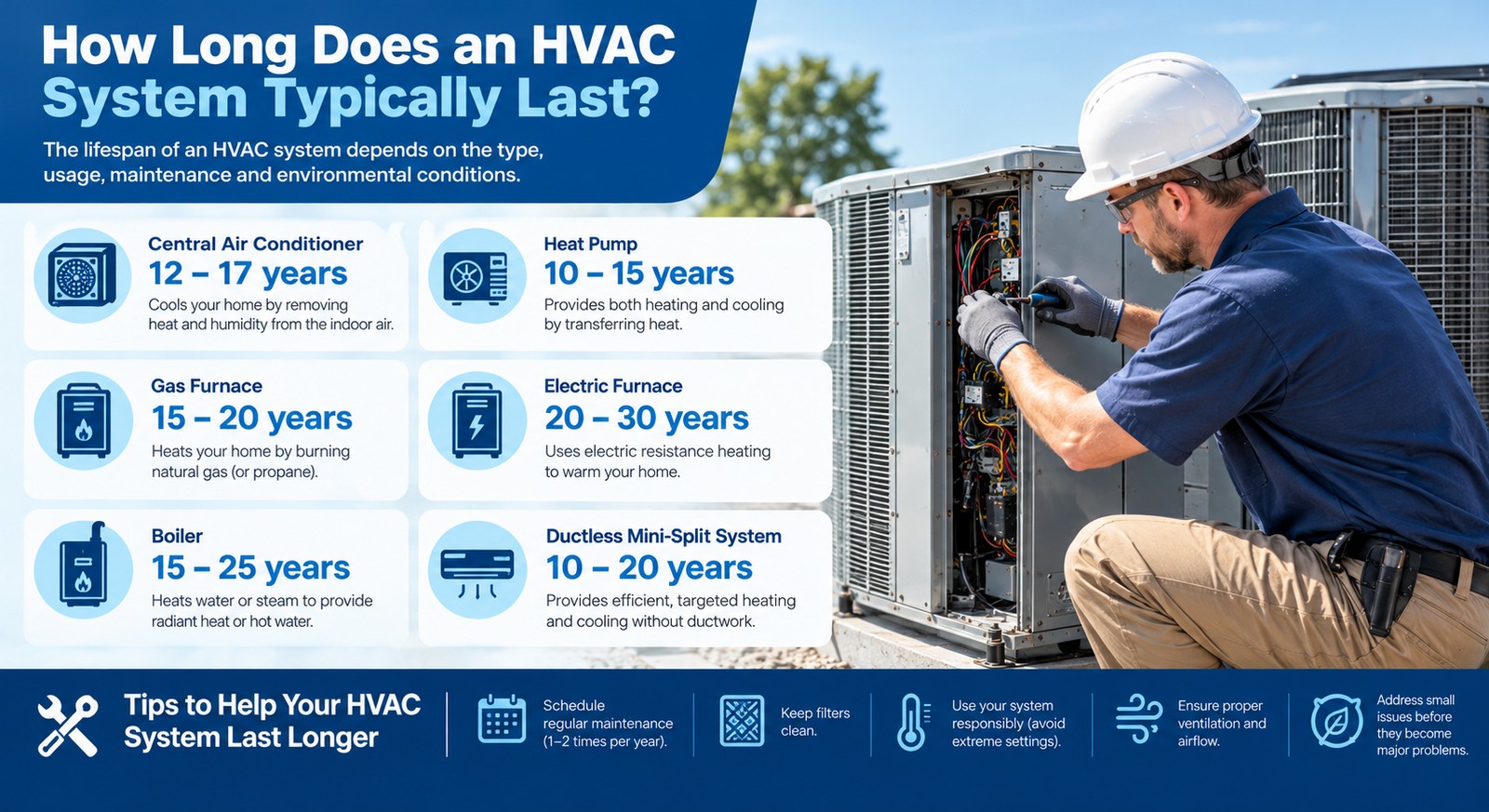
Most residential central AC systems last approximately 12 to 17 years, although some may need replacement sooner and others may remain functional for longer.
In hot climates, air conditioners may operate for extended periods, placing more cumulative demand on their components. Dust, moisture, and corrosive environmental conditions can also affect performance.
As a central AC system ages, you may notice longer cooling cycles, uneven temperatures, unusual noises, or rising electricity consumption.
These symptoms do not automatically mean the system needs replacement. A professional inspection can determine whether cleaning, maintenance, or a specific repair may restore its performance.
2. Heat Pumps: 10–15 Years
Heat pumps provide heating and cooling by transferring heat rather than generating it directly through conventional combustion.
During warm weather, a heat pump removes heat from indoor air. In colder weather, it can reverse its operation to move heat indoors.
Many residential heat pumps last approximately 10 to 15 years, although service life varies with operating conditions and maintenance.
Because a heat pump can operate throughout the year, it may accumulate substantial operating hours. Its reversing valve, compressor, fans, and controls are among the components that can eventually require repair.
To help extend a heat pump's life:
• Replace or clean filters as recommended.
• Keep outdoor airflow unobstructed.
• Schedule appropriate preventive maintenance.
• Address unusual sounds or declining performance promptly.
• Ensure the system is properly sized and installed.
A heat pump that receives consistent maintenance may provide reliable service for many years. However, recurring compressor or refrigerant-system problems may make replacement worth considering.
3. Gas Furnaces: 15–20 Years
Gas furnaces generate heat by burning fuel and distributing the resulting warmth through a home's ductwork.
A typical residential gas furnace may last around 15 to 20 years, although actual lifespan depends on the equipment's quality, usage, installation, and maintenance.
Important furnace components include the heat exchanger, burners, ignition system, blower motor, and safety controls. Over time, these components may experience wear, corrosion, or other damage.
Furnaces also require safety-related inspections. A cracked heat exchanger or malfunctioning combustion system can present serious risks, including potential carbon monoxide exposure.
Never ignore a suspected gas leak, carbon monoxide alarm, or other combustion-related warning. Leave the affected area if necessary and contact the appropriate emergency or qualified service provider.
Regular professional maintenance helps identify developing problems and verifies that the furnace is operating safely.
4. Electric Furnaces: 20–30 Years
Electric furnaces can sometimes last longer than gas furnaces because they do not use burners or a combustion heat exchanger.
Many electric furnaces have a potential service life of approximately 20 to 30 years, although individual results vary.
Their main components include heating elements, electrical controls, wiring, and blower motors. These parts can deteriorate with repeated use.
Electrical furnaces are not maintenance-free, however. Dust buildup, restricted airflow, damaged wiring, and failing components can affect performance and safety.
If an electric furnace repeatedly trips a breaker, produces unusual burning odors, or fails to heat properly, have it inspected rather than repeatedly resetting the electrical protection.
5. Boilers: 15–25 Years
Boilers heat water or another suitable fluid and distribute the heat through radiators, underfloor heating systems, or other heat emitters.
A residential boiler may last approximately 15 to 25 years, depending on its construction, water quality, maintenance, and operating conditions.
Common factors that influence boiler longevity include:
• Corrosion and scale buildup.
• Water pressure problems.
• Leaks or damaged connections.
• Pump and valve deterioration.
• Poor combustion or control performance.
• Infrequent maintenance.
A boiler that receives proper servicing may continue to function beyond its typical expected lifespan. However, persistent leaks, corrosion, declining performance, or expensive component failures may indicate that replacement should be considered.
6. Ductless Mini-Split Systems: 10–20 Years
Ductless mini-split systems provide heating and cooling without requiring traditional ductwork. They are commonly used for individual rooms, home additions, apartments, and buildings where installing ducts would be impractical.
A ductless system may last approximately 10 to 20 years, depending on its quality, usage, maintenance, and environmental conditions.
Indoor filters need regular attention, while outdoor coils must remain sufficiently clear to allow proper airflow.
Dirty filters, clogged condensate drains, refrigerant problems, and electrical faults can reduce performance or lead to repair needs.
Because ductless systems often contain specialized electronic controls and inverter-driven compressors, repairs may require technicians familiar with the specific equipment.
7 Factors That Affect How Long an HVAC System Lasts
Although average lifespan estimates provide a useful starting point, the actual life of your HVAC system depends on several important factors.
1. Quality of Installation
Proper installation is one of the most important factors in HVAC longevity. An incorrectly installed system may experience airflow problems, refrigerant issues, excessive cycling, poor drainage, or unnecessary mechanical stress.
Incorrect sizing can also affect performance. An oversized air conditioner may cycle too frequently, while an undersized unit may struggle to maintain comfortable temperatures under demanding conditions.
Professional installation should account for the building's heating and cooling requirements, ductwork, airflow, equipment specifications, and applicable codes.
Even high-quality equipment can experience premature problems if installation is inadequate.
2. Regular Maintenance
Routine maintenance helps identify developing problems before they cause significant damage.
Depending on the system, maintenance may include inspecting electrical connections, checking controls, examining coils, verifying airflow, cleaning appropriate components, and evaluating condensate drainage. Filters should be cleaned or replaced according to the manufacturer's instructions.
Skipping maintenance does not guarantee early failure, but neglect can allow dirt, restricted airflow, drainage problems, and component wear to go unnoticed.
A consistent maintenance schedule can help preserve performance and improve the chances of reaching the equipment's expected service life.
3. Frequency of Use
An HVAC system that operates for many hours every day may accumulate wear faster than one used only occasionally. For example, an air conditioner in a hot climate may run for extended periods during much of the year. A heat pump may operate during both heating and cooling seasons.
However, operating hours alone do not determine lifespan. Equipment quality, operating conditions, installation, and maintenance also play important roles.
Using appropriate thermostat settings and addressing performance problems can help avoid unnecessary strain.
4. Climate and Environmental Conditions
Local weather and environmental conditions can significantly affect HVAC equipment. High temperatures may increase cooling demand, while severe cold can place additional demands on heating equipment.
Dust, humidity, salt-laden air, and other environmental factors may contribute to dirty coils, corrosion, drainage problems, or deterioration of exposed components.
Outdoor equipment should have adequate clearance and be maintained in accordance with the manufacturer's recommendations. In areas with heavy dust or airborne debris, filters and coils may require more frequent attention.
5. Air Filter Condition
Air filters trap dust, lint, and other airborne particles before they enter the HVAC system.
When a filter becomes excessively dirty, it can restrict airflow. This may reduce cooling or heating performance and, in some systems, contribute to overheating or evaporator coil freezing.
Check your filter regularly and follow the recommended replacement schedule.
The correct filter type is also important. A filter that is incompatible with the system or creates excessive airflow resistance can cause problems even when it is relatively clean.
6. Correct System Sizing
An HVAC system should be selected according to the heating and cooling requirements of the building.
Oversized equipment may cycle too frequently, potentially reducing comfort and increasing wear on components that start repeatedly.
Undersized equipment may run for extended periods without meeting demand, especially during extreme weather.
Proper sizing takes into account factors such as building size, insulation, windows, air leakage, occupancy, climate, and other heat sources.
If an older system has consistently struggled to maintain comfortable temperatures, an HVAC professional can determine whether the problem is related to equipment condition, sizing, or another issue.
7. Quality of Equipment and Replacement Parts
Equipment quality can influence durability, repairability, and the availability of replacement components. However, a higher purchase price does not automatically guarantee a longer lifespan.
When choosing a replacement system, consider the manufacturer's specifications, warranty terms, installation quality, expected maintenance needs, parts availability, and the suitability of the equipment for your home.
The best system is one that meets the building's requirements and can be installed and maintained properly.
7 Signs Your HVAC System May Be Nearing the End of Its Life
An aging HVAC system does not necessarily need immediate replacement. Nevertheless, certain symptoms can indicate that the equipment is approaching the end of its useful service life.
1. Frequent Repairs
If your HVAC system needs repairs repeatedly, it may be experiencing widespread wear rather than a single isolated problem.
Keep a record of repair dates, costs, and the components involved. This information can help you and your technician assess whether continued repairs are sensible.
2. Rising Energy Bills
An older system may consume more electricity or fuel as its performance deteriorates.
However, higher energy bills can also result from changes in weather, usage, utility rates, insulation, or thermostat settings.
If energy costs rise alongside declining comfort or unusually long operating cycles, an inspection can help identify the cause.
3. Uneven Heating or Cooling
Rooms that remain too warm or too cold may indicate a problem with the HVAC equipment, ductwork, insulation, airflow, or system sizing.
If the issue persists despite basic checks, a professional assessment can help determine whether the cause is related to aging equipment or another part of the building.
4. Unusual Noises
Banging, grinding, persistent buzzing, or other new noises may indicate mechanical or electrical problems.
Some issues can be repaired relatively easily, while others may involve major components.
Have unusual noises investigated promptly, particularly if they occur alongside reduced performance.
5. Inconsistent Thermostat Performance
If the system repeatedly struggles to reach the desired temperature or cycles abnormally, the problem may involve the thermostat, electrical controls, airflow, or a mechanical component.
A diagnosis is important before concluding that the entire system needs replacement.
6. Visible Corrosion or Deterioration
Corrosion, damaged insulation, persistent leaks, and deteriorating connections can indicate that equipment needs closer inspection.
The significance depends on the affected component and the severity of the damage.
7. Declining Comfort
If your home is consistently less comfortable than it used to be, despite similar operating conditions, your HVAC system may need service.
A technician can evaluate the system's performance and determine whether maintenance, repairs, or replacement would be most appropriate.
How to Extend the Lifespan of Your HVAC System
You cannot prevent every mechanical failure, but consistent care can help your HVAC system operate reliably and may extend its useful life. Here are some practical steps.
Replace Filters as Recommended
Inspect filters regularly and replace or clean them according to the manufacturer's guidance.
The appropriate interval varies depending on the filter, equipment, operating hours, and indoor conditions.
Schedule Preventive Maintenance
Arrange periodic professional maintenance appropriate to your system.
A technician can inspect important components, check system operation, identify developing faults, and recommend maintenance based on the equipment's condition.
Keep Outdoor Units Clear
Remove leaves and loose debris from the area around outdoor equipment. Maintain the manufacturer's recommended clearance to support proper airflow.
Do not open electrical compartments or attempt internal repairs unless you are appropriately qualified.
Keep Vents and Returns Unobstructed
Make sure furniture, curtains, and other objects do not block supply or return vents. Restricted airflow can affect comfort and increase system strain.
Use Appropriate Thermostat Settings
Choose settings suited to your comfort needs and local conditions. Avoid unnecessary extreme temperature settings that force the system to work harder than required.
If your thermostat offers scheduling features, use them to match system operation to your routine.
Address Problems Early
Do not ignore weak airflow, unusual noises, persistent water leaks, ice buildup, or repeated system shutdowns. Early diagnosis may prevent some faults from developing into more serious problems.
Maintain Proper Ventilation and Drainage
Where applicable, ensure that condensate drains remain clear and that the equipment's drainage arrangements function properly.
Persistent moisture problems should be investigated to prevent damage to the equipment or surrounding building materials.
Keep Records of Repairs and Maintenance
Maintain a simple record of service visits, replaced components, warranty details, and recurring problems.
These records can help identify patterns, support warranty claims, and inform future repair-or-replacement decisions.
Conclusion: Get More From Your HVAC System
Most residential HVAC systems provide many years of service, but their actual lifespan depends on the type of equipment, installation quality, maintenance history, climate, and operating conditions.
Central air conditioners often last around 12 to 17 years, heat pumps around 10 to 15 years, and gas furnaces around 15 to 20 years. Other systems, including some electric furnaces and boilers, may remain operational for longer.
Regardless of the equipment type, routine maintenance and prompt attention to developing problems can help preserve performance and reduce avoidable wear.
If your HVAC system is aging, experiencing frequent breakdowns, or struggling to maintain comfortable temperatures, consider arranging a professional inspection. An accurate assessment can help you determine whether maintenance, repair, or replacement is the most practical next step.
For homeowners researching asap heating and cooling, understanding your equipment's age and condition is a useful first step toward making informed heating and cooling decisions.
With appropriate maintenance, timely repairs, and careful replacement planning, you can get the most practical value from your HVAC investment while keeping your home comfortable throughout the year.